Remarks on the Proposed Cannabis Legalization Law in Lebanon


Shortly after I made the proposed draft law public yesterday, the frustration became palpable with many Lebanese citizens, especially the youth. The reason I posted it immediately without writing a more in-depth analysis, is because it was on the parliamentary committee’s agenda, and we needed to mount pressure quick before they OK it and send it to the general assembly. That seemed to have worked, since it wasn’t even discussed.

Skoun, a treatment center and NGO I absolutely adore and have worked with many times over the years, made a more detailed analysis of the law, and with their expertise wrote several remarks about the law and why it’s a bad one. I will attempt to roughly translate it here from the Arabic version they sent me and which we are forwarding to MPs from every political party.

Skoun’s Remarks:

From Facebook: (as is, not translated)

After reviewing the draft law, Skoun insists on the necessity of revising and amending the current version of the draft, taking into consideration the following concerns:

First, it is surprising that this draft has not once mentioned the decriminalization of drug use and has ignored the proposal to amend the current drug law submitted to the Lebanese Parliament in June 2016. Even more surprising is that some of the signatories of this draft were on the frontline of calling for the amendment of the Lebanese drug law. We believe that the health and rights of our young men and women have always been, and continue to be a priority that is far more important than any revenue that this draft may bring to the Lebanese economy. Therefore, any reform of Lebanon’s drug policy must begin with an end to the criminalization of drug use and an adoption of public health based approach. (We recall here the difference between decriminalization and legalization of drug use).

Second, Skoun objects to the inclusion of “personal consumption” under the penalties and sanctions section of the draft law. Besides the fact that the sanctions carried are extremely heavy and are in contravention of the basic principles of human rights (hard labor for life), the essence of the sanctions associated with “personal consumption” are also contradictory to the direction adopted by the government, civil society working in drugs, as well as human rights organizations that call for the decriminalization of the use of drugs. The Inter-Ministerial Substance Use Response Strategy for Lebanon 2016–2021, developed by the Ministries of Public Health, Interior, Justice, Social Affairs and Education and Higher Education, expressly sets as an objective the revision of the “law towards the decriminalization of illicit drug use in line with international treaties and public health principles.”

Third, Skoun wonders what the law’s vision for this transitional phase between an illicit market and a regulated legal market? What are the mechanisms put in place by the draft law to ensure the protection of the rights of current cannabis cultivators (Farmers)? Will they be included and allowed to profit from the regulated market? Will the new law provide an amnesty to the “cultivation of illegal substances” crimes they have been convicted of, which, under the draft law pose an obstacle to their acquisition of a legal permit to cultivate cannabis?

Finally, Skoun asks will the draft law ensure the access of Lebanese citizens, in particular cancer patients, to the plant for medicinal purposes.

From the statement shared with MPs: (my rough translation)

Granting Permits

The proposal is inherently discriminatory towards current cannabis farmers, given that a main prerequisite is a clean criminal record, when a large portion of current farmers do not have a clean criminal record given most are convicted of the felony of growing hashish. This ignores the rights of these farmers the law is supposed to help, denying them the transition from illegal to a regulated market.

Article 21

The requirement of judicial records for everyone that will be employed in hashish growing is irrational, given most workers in this industry are convicted because of the type of work they do.

Article 39

First, the suggested sentences are extremely harsh. Hard labor goes against basic human rights, and can be considered as torture according to international standards, which comes as shock given Lebanon ratified a law that bans torture recently. This also fails to live up to the notion that the punishment should be equivalent to the crime.

Second, this article puts farming and promoting the use of hashish in the same category with the same penalty, which goes against the principle that the penalty should be comparable to the crime.

Third, the failure to clearly define what is “promoting” leaves the possibility open for abuse of this provision in terms of how law enforcement enforces it, and how the judiciary rules by it. Theoretically, this provision could mean anyone caught with a small amount of hashish can be indicted with “terweej”. A current example is with the current Drugs Law number 673 in Lebanon, where the justice system has found it difficult to properly define “promoting”, leading to thousands of young men and women incarcerated for simply having a small amount on them.

The fact that “personal use” is mentioned as something punishable under this law, with an extremely harsh penalty, clearly contradicts the direction the Lebanese government has been going in recently, as well as civil society actors who work in drug awareness and treatment, and organizations that work on the legal and human rights aspects. The general consensus among all these stakeholders is that penalty for personal use should be abolished. This was clearly outlined in the “Joint Strategy Between Ministries to Counter Drug Abuse and Addiction 2016–2021” which the ministry of public health, justice, interior affairs, education and social affairs worked on together, which included: “revision of the current laws to abolish criminalizing illicit substances to fulfill Lebanon’s commitment to inernational conventions and public health principles”

The Proposed Medical Cannabis Law is a DISASTER

Our worst nightmares have come true. The proposed law to enrich our horrible politicians is worse than any of us ever imagined.

For one, it makes the punishment for cannabis use exponentially worse than it already is under the current, disgusting law.


For two, it excludes current farmers from getting “permits” to grow, their main excuse to legalize cannabis cultivation, since it wants people with “clean” records only to get it. We all know most if not all farmers are outlaws, so they want to get in their own people to farm it, not help the ostracized communities as they claim.

For three, the Ministry of Public Health hasn’t even been given the draft law to look at the “medical” merits of this proposed law.

For four, our politicians wanna sell it for medical use, but will not allow its medicinal use in Lebanon for Lebanese.

I have attached the draft law here for everyone to see, and to see which members of parliament are guilty for not just ripping us off from the money this might generate, but also ruining thousands upon thousands of more lives.

FULL DRAFT LAW

I am working with several people to detail all the horrible things in this law, and how it is even worse than our worst nightmares and will only help the corrupt politicians who signed this, not the country’s income, nor help end the tyranny of drug enforcement in Lebanon, especially for use of a plant these politicians wanna get rich off of, but put their taxpayers in jail and through hell if they try to use the plant for medical purposes here.

Stay tuned for a more in-depth analysis of this disaster, but till then, if you have contact with any of the MPs who signed this, call them and ask them to stop this vote TODAY!

The names signed are of the following MPs, based on what I could read and gather from multiple sources in parliament:

  • Michel Moussa
  • Mustapha El Husseini
  • Mohamad Khawaja
  • Salim Aoun
  • Henry Helou
  • Akram Chehayeb
  • Jihad El Samad
  • Paula Yaacoubian
  • Nicolas Nahhas
  • Albert Mansour

If any of these names are MPs from your district, or the party you support, then get in touch with them and tell them NO to this draft law. Tell them NO to passing it in secret and with ZERO regard to their constituents’ rights.

This will make the situation of cannabis in Lebanon a thousand times worse than it already is. They have lied to us and kept this law from us as they tweaked it to their ow benefit, not to the benefit of the country, and us, its citizens.

The Ballroom Blitz: Beirut’s New Mega Music Venue

The Ballroom Blitz Venue

I heard rumors about a multi-room club somewhere near the auxiliary seaside road back in 2016, and have been poking my nose there ever since. On Friday, I got an exclusive first look and tour as the team behind The Ballroom Blitz Venue put the final touches before they officially open on Friday October 5, 2018.

The Space

The Ballroom as seen from the middle of the dancefloor

The Ballroom is the largest room and will host their main events. Patrons will walk through a curving tunnel-like corridor that connects the acoustically-separate rooms and areas in the venue.

The venue’s team want this room to be a contemporary version of a traditional ballroom: it has a stage, a massive dance floor and seating on both each side.

The space was designed with more than just electronic music in mind, with a 7-piece band easily accommodated on the elevated stage. There’s also a large balcony area on one side.

What I liked is that the tables aren’t the main fixture, and are instead pushed to the side and kept at a minimum to maximize the dance floor.

View from the balcony area

The Gold Room

This is already my favorite room. The entire space is built like a studio, with a room inside a room that’s completely insulated from the rest of the venue, a bonafide Hi-Fi club room where artists are encouraged to experiments, and the large LED screens are replaced with more organic lighting elements and the beautiful bare concrete columns.

The Gold Room

The Lobby will be the first stop in the club. The large bar and outdoor terrace open at around 10:30PM and stay open till the venue closes. Imported beers, whiskies, sake, signature cocktails and other not-your-average party drinks will be served. The Lobby is the place to socialize and take a breather, before going back through the 21dB-designed acoustic tunnels into The Ballroom or the The Gold Room.

The Concept

I can already imagine beautiful nights in each of the two main rooms at Ballroom Blitz. The club will open on Fridays only, which I think is great given the increasingly crowded Saturday night schedules in Beirut. It’s also refreshing to see someone getting into the music scene with their own thing, not just to supplant players already in the game.

Techno will have a sizable role to play, and I was ecstatic to know that they will soon host artists from the legendary Ostgut Ton (Berghain’s label). However, the club will focus on a variety of musical genres, and would more appropriately be called a musical venue, not just a club. Here’s a taste of what’ to come:

https://instagram.com/p/BoTXl3VhE9R/

The Details

It opens this Friday. You can RSVP on Facebook here.

All three spaces are open to everyone at the club. As we have gotten used to with Ballroom Blitz nights, come with an open mind and expect to hear something new and artists experimenting beyond the usual sets you’d expect.

https://www.facebook.com/events/672039019861645

El Gherbal Initiative: Visualizing Lebanon’s Fight Against Corruption


I received an early copy of the above infographic from the awesome peeps behind El Gherbal. I thought it’d be the perfect chance to introduce you to this groundbreaking initiative and their first, incredibly diligent and detailed 150+ page report on the cooperation of different public institutions with the new “access to information” law passed in Lebanon last year (RLAW).

What’s Gherbal?

Gherbal Initiative (GI) is a non-profit civil company founded in 2017.

Their stated mission is to push for transparency and accountability in Lebanon. Gherbal means “sift” in Arabic, which is what they plan to do with the data they collect, analyze and visualize.

GI’s founder tells me that the initiative is built on the belief that democratization of data can act as an catalyst in the fight against corruption. The plan is to collect and convert complex data sets into easily, freely accessible engaging visuals that can help better frame public discourse and ideally lead to concrete political action.

Their first monumental task was on the access to information law passed in February 2017. Below is a video that briefly explains the RLAW, and subtly critiques its shortcomings.

The Report

Honestly, I was blown away. Took me a full 2-days of going through it all and pondering each of the data sets and corresponding visual representations. The work was incredibly diligent and painstaking, and not all the findings were as terrible as you imagine. Some institutions and individuals in the public domain were actually cooperative with information requests, although just about a quarter of the ones GI contacted.

You can download and read the FULL report in English here.

Examples of What’s in the Report

Visuals about responses or lack thereof.

Security Authorities Replies/Non-Replies

Timelines of the various institutions, if they replied at all, and if they did so within the legal deadline.

Timeline of attempts to get information from the Presidency

Actual responses they received.

The actual reply from the Judicial Council

I Love This

Many of the fights we’ve had against the status quo, often fell short for one main reason: lack of data. Even when there was data, it was hard to break it down into something usable for the majority of us who don’t have the expertise, or time, to decipher the legalese and bureaucratic procedures that are often thrown in front of taxpayers requesting information. GI did that for us, and I hope to see more of their work in the near future, which is very valuable ammo in advocating for proper change and an end to rampant corruption in our country.

Many times, we complain that the law isn’t being applied, without ever trying to make use of it ourselves. It’s awesome GI didn’t sit aside, and decided to actually give the chance to over 130 institutions to comply with the new law, and some actually did. After all, how can we expect them to do the law, if none of us are trying to use it?

I hope GI continue this awesome initiative, and look forward to seeing their next comprehensive report. I highly recommend you check out their website (EN/AR) here.

Siemens CEO Confirms an Electricity Offer Was Made to Lebanese Government


Lebanon has been abuzz the last few weeks with chatter about an alleged 300 million USD offer by Siemens AG to fix Lebanon’s disastrous electricity problem.

Some folks deny it, others swear by it, we even all got a voice note by a Lebanese MP sounding off about it, which most people I think kinda supported.

The Tweet

Twitter user @YaraAlandary tweeted Siemens AG CEO Joe Kaeser, asking him if the offer was true and they did propose it to the government when they visited with the German Chancellor. Tonight, Mr Kaeser replied, saying:

Yes, we did. During the visit w/ our Chanellor, I did offer to help improve the whole electricity value chain and have our team to come in and assess what’s best for the people. No response yet from Government. Our door is open! Offer still good. Call Anytime! @Siersdorfer_D

He also tagged Siemens Middle East CEO Dietmar Siersdorfer and keeping the offer on the table, and “call any time”.

No One Knows the Exact Proposal Yet

The 300 million USD number might be wrong, and it’s not clear what the offer was exactly, but the tweet reply by Lebanon’s Energy Minister came a couple hours after the Kaeser’s tweet.

We look forward to cooperating with Siemens on needs assessment, and accordingly maybe receiving a formal proposal

The minister seemed to limit the possible collaboration to just “needs assessment” and “maybe a receiving a formal proposal” suggesting the one apparently proposed during Merkel’s visit (and still stands according to the CEOs of Siemens) wasn’t official.

This is what the minister said the offer was on LBCI. Watch here.


Keeps Getting Fishier

With all the pushback suggesting the “rumors” were unfounded, tonight’s tweet by Siemens’ Kaeser was a twist in the never-ending blackhole that is Lebanon’s decades-old electricity problem.

At the end of the day, we as taxpayers who spend most of our nights in darkness, and hot summer days with no AC, 28 years after the war ended, and way too many billions poured into that sector, and we still don’t fucking have electricity for more than a few hours a day.

I hope Siemens will make their offer public, or parts of it at least, and that the Lebanese government elaborates the rationale behind refusing or at least ignoring such an offer?

UPDATE: the minister tweeted this follow up tweet.


The Cedars: Lebanon’s Hockey Team Based in Montreal


Lebanon has an ice hockey team, based in the Canadian city of Montreal. The team is in its second year now, and in their first season last year, they made it to the final game of the Arab Cup held in Abu Dhabi.

I was extremely delighted when I heard the news. I properly discovered hockey when I lived in DC for a few months back in 2013, where the Washington Capitals are arguably the city’s favorite sports team. It’s a fast, intense and violent game. It’s a game where players can actually brawl, legally. Ever since I became interested with hockey and watching a few games live, I cringe even harder now when I see Neymar or Ronaldo in their Oscar-nominated performances of being mortally wounded when a finger grazes their elbow.

The next goal of the young Lebanese team is to get recognized by the international governing body of the sport, the International Ice Hockey Federation (IIHF). Countries like Morocco, United Arab Emirates, Oman and Qatar already have federations recognized by the IIHF.

Most of the players are Canadian-born young men from Lebanese descent.

Hockey’s fast and intense pace might be something Lebanese audiences enjoy, but I’m not sure anyone’s ever properly tried to build up this sport in Lebanon. I remember a few street hockey get-togethers back when I was in high school, but that’s about it.

Given Lebanon doesn’t even have an ice rink anymore, I’m not sure how the sport will gain traction, but if we take international rugby as an example, then team Lebanon’s impressive performance on the world stage will definitely make the sport more popular in Lebanon.

The Cedars won 7–5 in the game with Argenteuil Hockey Club last week

I hope to see more success for Lebanon’s national hockey team. Stay up to date with them here.

Go Cedars!

23 Lebanese Landmarks on Google Street View


Anyone who relies on Google Maps in Lebanon, knows that it’s far from perfect. Roads that don’t exist, an inability to tell one-way streets from two-lane ones and the absence of newly established roads on the app that has become an integral part of all our lives. Don’t use it much? Well, if you ever order a cab with ride-hailing apps, you’ll know that your driver will get lost at least half of the time when they rely completely on the Google maps navigation.

However, the Google Maps “Street View” option is now available for a couple dozen important landmarks in Lebanon. Those include the Baalbak, Jeita, Tyre and Sidon, Beaufort Castle, the Chouf Cedar Reserve, the National Museum as well as AUB, LAU and LIU campuses, among other locations across the country.

The difference between that and panoramic photos or 360 panoramas, is that you can “walk” along the paths and streets by tapping further along the road. This lets you actually walk around the locations and monuments, not just see them from one vantage point. In many cities around the world, you can see almost every street, which if you’re trying to make sure a restaurant’s address is correct on maps, really helps, cause you can street view it and make sure it’s still there.

So, the next time you wanna try and convince someone that we’re not just deserts and camels here, maybe send them a link of one of your favorite spots now available on Google Street View.

You can find them all here.

Master’s or MBA? Find Out at the QS World MBA & Grad Tour in Beirut on September 24


I started this blog when I was doing my undergraduate studies back in 2010. Today, almost 9 years later, the biggest chunk of my readers are in my age range. This means that many of you are considering whether to get your Master’s or MBA degrees.

If you’re anything like me though, chances are you feel choosing the right option for you, the right school and figuring out how to pay for it all or if you can get a scholarship or financial aid, are all very daunting tasks. I don’t even know where to start, especially given I’d prefer to do my prospective Master’s degree somewhere abroad and take a break from Lebanon for a couple of years.

That’s when I found out about the 2018 QS World MBA Tour and the QS World Grad Tour happening in Beirut this year on September 24th at the Four Seasons Hotel in Beirut.

Here’s a little background to prepare you before you check them out later this month.


MBA vs Master’s

If you’re not sure which is the right choice for you to continue your education, let’s break down the major differences between the two types of programs.

MBAs are designed to build upon your life and career experience so far, and are often a more general approach to develop and put to better use what you have learned in the past few years to help you get back into your field with an edge (and sizable salary bump of course!)

Master’s degrees are usually designed to build upon your academic background. This means that instead of a more general approach to help you better manage in your business and financial sectors, Master’s degrees are much more specialized and help you become an expert in a particular industry or field you wish to continue and advance in.

Teaching Styles

To dive deeper into the differences between MBAs and Masters, it’s important to know that the teaching styles in each are very different.

MBAs rely mainly on case studies. These are often real-world examples of issues or challenges students would be expected to face after they graduate. Usually, small groups of students will explore, discuss and reflect on different case studies throughout their MBA program, helping equip them to dive back into their careers better prepared and ready for bigger challenges. Lectures like the ones you had in your undergraduate studies will also be featured, but much less than the case-study based work you will encounter during your MBA.

Master’s programs are built upon classroom and laboratory-based activities, presentations and lectures. It’s basically a more advanced, more specialized form of what you encountered during your undergrad time. What’s important to note, is that even though Master’s degree programs might include work in small groups, the emphasis is always on the individual and independent learning of each student, unlike MBA degrees where work in small student “syndicates” is more important.

Specializations

Apart from the teaching styles and formats, the main difference between a Master’s and an MBA is the level of specialization depending on the area a student would like to advance in.

MBA programs are usually perfect for a student who wants to better equip themselves for a wide range of business-related situations. Students seeking a more specialized set of skills usually choose a Master’s qualification for their postgraduate studies with a more precise academic and theoretical framework for their chosen area of study.

A good example to help you better understand the differences between an MBA and a Master’s program, is the ability to choose the courses you want. A typical MBA program might include 12 courses, only four of which are electives a student can choose. In a Master’s program, far less courses are chosen for you, and you can elect to register for more courses of your choosing, depending on what you aim to get out of your postgraduate studies.

One real-world example is for students who are hoping to get into the Human Resources area in their future career. An MBA will have more general business courses, and a handful of HR specialty ones. If you already know that HR is the road you want to take, a more specialized Master’s in HR management will better your chances with employers looking for an HR manager. If you’re unsure which management position you’d like to go for in the future, an MBA will keep more options open for you, but make you less competitive for more specialized positions.

What Should You Choose?

The debate about the pros and cons of MBAs vs Masters degrees will not end anytime soon. At the end, it all boils down to two main factors:

The first, is if you’ve already made your decision about the specific direction you hope to take your career in. If that’s the case, a Master’s degree is right for you. If you’re not a 100% sure where you want to end up in your career, then a more generic, business-focused MBA program might be the better choice.

The second factor to consider is your background, experience and qualifications. International MBA and Master’s program that you probably want to attend require pretty specific entry qualifications. Whether it’s your scores on the GMAT or GRE, your past professional experience, academic achievments or even the languages you speak, they all factor in to help you figure out which type of degree and which university would be the best fit for you.

Need Help Figuring It Out?

I tried to narrow it down for you guys here as much as I can, but we both know it goes far beyond the points I raised above. If you want to pursue higher education, but still can’t decide what would present the highest ROI for you and your career, then head down to the QS World MBA and Grad School Tour in Beirut on September 24.

To get an idea about the ROI for all you business-heads, here’s a few points from the QS Trends and Salary Report of 2018

MBA salary levels increase after dip in 2016; MBA employers in the US & Canada are the most generous ($98,900, increasing to $116,300 with bonus), pulling away from Western Europe ($85,500, increasing to $101,300).

Highest MBA salaries on offer in Switzerland ($123,500), followed by US ($102,100). France ($98,500) and UK ($92,400) are next best performers in Europe. Australia leads the way in Asia-Pacific ($98,400), followed by Japan ($80,000).

(source)

(source)

The event will feature admissions directors from universities across the globe, including: LBS, INSEAD, IE, Toronto-Rotman, Arizona State, Warwick, Manchester, CKGSB, Bocconi, King’s, EDHEC, SKEMA, HEC- Paris, Imperial, NYU and many more.

Apart from that, you can attend admissions seminars, LinkedIn and GMAC workshops and gain access to a pool of scholarships worth 7 million dollars.

Book your spot by registering online for:

MBA event here

Masters event here.

B 018: The End of an Era, And Start of a New One


Facebook notified me today that I’ve been friends with Ziad Ghosn, one of B018’s legendary resident “decknicians” for 11 years today. That’s just a fraction of how long the subterranean bunker has been open though.

B018 is undoubtedly Beirut’s most iconic club. On so many occasions, fellow clubbers I meet in cities like Berlin, DC and Brooklyn, when they found out I’m from Lebanon, they inevitably ask about B018. Most heavyweight artists made their Beirut debut in the underground bunker in the Lebanese capital’s former quarantine area: Karantina.

Whether it’s the design, the concept or the music, b0 has captured the hearts and minds of generations of clubbers. It perfectly symbolizes what a club should be, especially a Techno-focused one: reviving an industrial, down-trodden part of an urban metropolis and breathing life back into it.

Karantina saw some horrible things throughout its history, and even in modern times, it’s largely been an industrial area with warehouses, slaughterhouses and granaries replacing refugee camps, residential areas and other non-industrial buildings that once stood there.

The design never shied away from the brutal history, with a bomb-shelter like venue with furniture that looks like stacked coffins when closed, that turn into comfortable couches when opened. Never pretending to ignore the bad memories, b0 sought to change them into something nicer today, creating new memories in a place most of us grew up driving by and never giving a second thought.

The End of an Era, but the Beginning of a Better One

With so many options to go out at night, even in the general vicinity of Karantina, it’s time for b018 to reinvent itself again. After two decades of massive influence on the culture, it’s time to rebuild, renovate and transform this Beirut icon.

Just for the record, B018 doesn’t mean “be over 18”, it’s actually the chalet number where the parties started back in the early 90s. Building B, chalet number 018. So, please stop working it BO, it’s B0.

This Friday, B018 as you know it will come to an end. It’s being redesigned by the original architect, Bernard Khoury, and will reopen later this year in its new format.

The new B018 will be joining forces with the growing uberhaus empire, with places like The Garten, Discotek and Uberhaus.

I promise I’ll share with you the new design, renders and plans as soon as I get my hands on them. Till then though, get ready for a fond farewell to a club that many of us have too many fond memories in to count.

B018, thank you for all the beautiful sunrises under the retractable roof. Can’t wait to see what’s in store for the next chapter!

https://www.facebook.com/events/1735355169895116/

Alfa and Touch: We Need to Talk About SMS Spam


I fucking hate SMS ads. I hate them even more when they’re from brands (or ministries) I don’t care about and have never and will never do business with. Lebanese people get thousands of unwanted SMS blasts every year, without an option to opt out of receiving them.

I’m on Android, so I’ve been blacklisting the biggest offenders for years. However, it got so bad, and they’ve become so many, that I disabled SMS notifications completely. After all, even the ones that aren’t ads just make me sad: it’s either my astronomically high Alfa bill (or my 4G consumption magically running out) or my bank reminding me how little is left in my account at the end of every month.

It might be a minor annoyance to most of us, but there is a serious privacy issue here, especially since most of the ads we get aren’t solicited, which begs the question, how did they get your number? And why are those ads still so badly targeted in 2018. It’s bad for us, it’s bad for brands and it’s bad for our telcos, and here are some reasons why:

Why That’s Bad for Us

I don’t want ads about a washing machine every week. I also don’t want to know for how much cucumbers are selling for at a big supermarket. I definitely don’t want to enter the next stage of a draw I never went into in the first place, to win 1000$ or riyals or whatever.

I might not mind an ad about an offer from a restaurant I like, or a reminder about a party I want to go to, but as long as I’m the one that gave them my number, signaling an interest to hear from them and get ads when they have something going on.

Now, I understand SMS is something no one uses anymore with online messaging apps and services, which means advertisers blast en-masse in hopes of someone actually seeing it. I might forgive that last ditch desperate effort, but I hate that I need to put up with it for years on end, with no option to stop them spamming me.

In most countries I’ve been to, telcos or spam SMS companies allow users to opt out of receiving SMS ads from that particular sender. In some, marketers would be fined or forced to pay your phone bill if they send you an SMS again after you decided to unsubscribe. In Lebanon, opting out is virtually impossible, and that’s our main problem with the junk SMS epidemic we all suffer from, even on new numbers.

Why That’s Bad for You

Most Lebanese already hate our telcos for the astronomically high price we pay for basic connectivity on our mobile devices. Why add to our woes with SMS blasts that constantly hound us?

Why sell our private numbers to advertisers at a premium, with absolutely no guidelines except a loose “no sex, no politics” ‘rule’ which seemed to have been on hiatus during the election season earlier this year…

You can easily solve this by allowing us to unsubscribe from some of those advertisers, or forcing the people you sell our data to, to include a way for us to unsubscribe from their twice-a-week update about cucumber prices.

Help Lebanese people hate you less, and allow us to make our SMS tab something we don’t dread and hate and would rather disable.

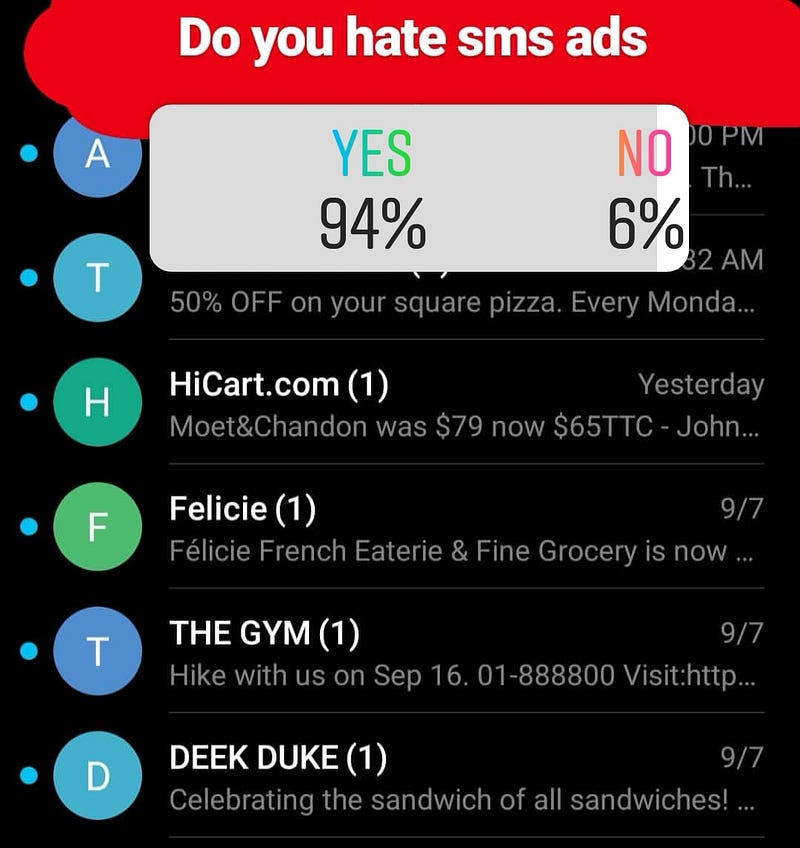
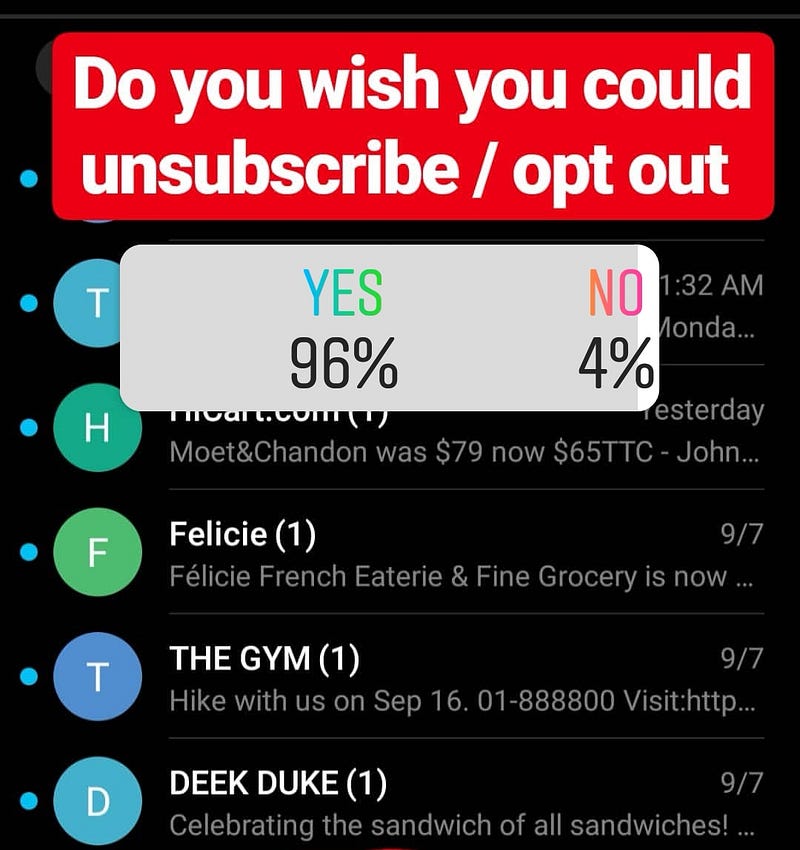
I ran a poll on my Instagram account yesterday, and here are the results based on 1261 taps for the first question, and 1357 for the second one.


Why That’s Bad for Companies

We come now to the brands that use SMS blasts to push their products, offers and services. I know times are bad and the situation is desperate, but bombarding phones whose numbers you’re not supposed to have will probably hurt your brand a lot more than help your sales.

Let’s say I love a brand. What will happen after I get 77 SMSes from them about something I already know about? I’ll start hating them, especially that they are sending me those annoying SMSes without me giving them permission to.

Let’s say I hate a brand. Do you think that by SMS #346 I’ll change my mind? Probably not. So, you guys are wasting your money on an ad that is wasting my time and lessening the chances I will ever part with a lira for your business.

A Simple Solution

Even though most of us would rather lose SMS completely, it is still useful in many instances. Like when your data limit is reached, or if you have 2-step authentication for logging in to your online accounts. Most still need it to get confirmation of your credit card payments, or a code to activate an account or app or WiFi connection on your layover.

Give us the option to opt out. It’s as simple as that.

When you sell our numbers to third party advertisers, make sure you include in the deal an option where they give a user the choice of unsubscribing.

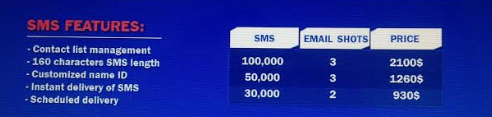
Instead of sending 100,000 SMSes to numbers that probably don’t care about your brand, try to gather a database of users’ numbers who actually might want to know about them, not everyone, and do that with people’s consent like when they give feedback at a restaurant.

The freakiest one for me is when SMSes use your billing information, such as how much you pay per month, to call and offer you loans and other financial services, given they know you pay a lot for your phone bill, and probably would qualify for a loan you don’t want. That was just creepy and a massive invasion of privacy that went beyond your number, but also your supposedly protected and secret finances.

Alfa and Touch, let us unsubscribe from SMS junk. Please.